Employee Appreciation Ideas Beyond the Gift Card
The employee appreciation ideas that land are the ones that cost a manager some thought rather than only some budget. A gift card says thank you and is forgotten by payday. What people tend to remember is being recognized by name in front of the colleagues whose opinion they care about, being handed back some time, or being taken somewhere they would not have gone on their own and sent home with something they made. Below is why most appreciation falls flat, how the usual formats compare, what an appreciation event asks of whoever is planning it, and where a hands-on winery on Long Island fits.
Table of contents
Why does most employee appreciation fall flat?
What we have noticed hosting teams since 2010
How do the usual appreciation formats compare?
Planning an appreciation event people will turn up to
Who a hands-on winery event is not right for
Where wineUdesign fits
Employee appreciation FAQs
The part that actually sticks
Why does most employee appreciation fall flat?
Usually it is not the gesture that is wrong. It is that the gesture arrives once a year and very little is said in between. Gallup's employee engagement research found that as of May 2026 only 29% of US employees said they had received recognition or praise for good work in the past seven days, and only 40% said there was someone at work who seemed to care about them as a person. Global engagement sat at 20% in 2025, down from 21% the year before.
An event does not fix that on its own, and we are not going to pretend otherwise. What those numbers do explain is why a single annual gesture often reads as hollow. If someone has gone seven days without hearing that their work was any good, a gift card in March is not recognition, it is an apology for eleven and a half months of silence. The appreciation that works is the kind that gets repeated and the kind that is specific, and an event earns its place when it creates a moment where specific things get said out loud.
The second reason appreciation falls flat is that it is often designed for the person giving it rather than the person receiving it. A catered lunch in the same room where people eat lunch anyway, an all-hands slide with everyone's name on it, a branded water bottle. These cost money and ask nothing of anyone, which is exactly how they feel on the receiving end.
What we have noticed hosting teams since 2010
We have been making wine in Hicksville since 2010 and more than 5,000 people have worked at our tables. Appreciation events have a different feel to an ordinary team night, and the difference is usually the manager.
The ones that work have someone who says a few specific things early, before anyone has a glass in hand, and then stops talking and joins a table like everybody else. Two minutes, names and particulars, no slides. After that the activity does the work. The ones that do not work are the ones where the person in charge treats the evening as a stage, or stays at the edge of the room answering email while the team blends.
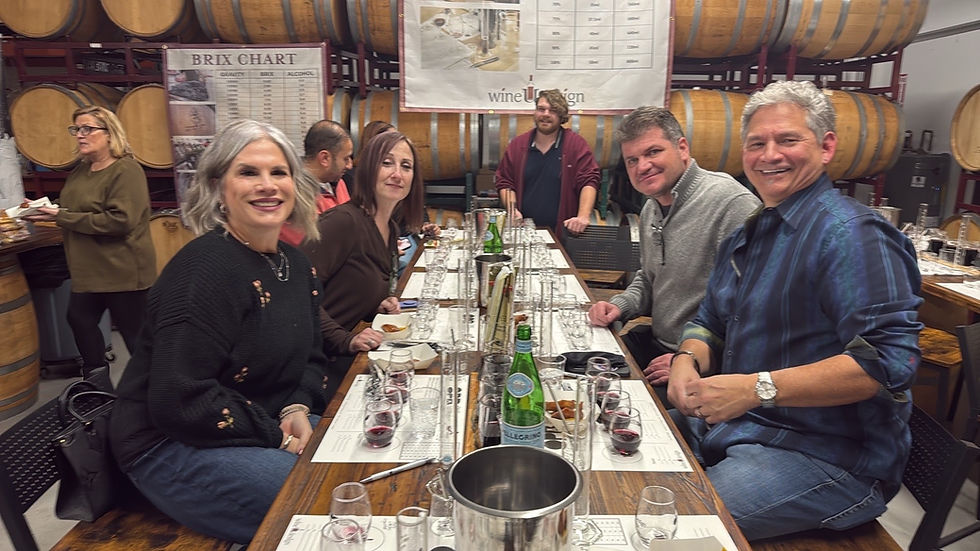
The other thing we see is that people relax once their hands are busy. Somebody who would dread being thanked in front of a room is perfectly happy being thanked across a table while they are arguing about how much Cabernet the blend needs. We seat 6 to 12 at a table for that reason, because below six the conversation dries up and above twelve somebody always ends up watching rather than doing. Nobody needs to know anything about wine, and most people arrive knowing nothing, which levels the room faster than any icebreaker.
The bottle matters more than it should. People take a bottle they made home and leave it on a shelf, and it keeps being a reminder of a good evening for months. That is the bit a gift card cannot do, because a gift card is spent and gone and nobody remembers what on.
How do the usual appreciation formats compare?
Each of the common options is good at something, and it helps to be honest about what.
The gift card is the honest baseline. It is fast, it scales to any headcount, people can spend it on what they want, and for a distributed team it may be the only practical option. What it cannot do is carry any specificity, which is the thing that makes recognition register. If you are going to send one, write something particular alongside it rather than the same line to forty people.
Extra time off is the one employees rate most highly and companies offer least. An afternoon back, a long weekend, a genuine no-email day. It costs capacity rather than cash, which is why it is harder to approve, but it is worth pushing for because it is the only item on this list that gives people something they cannot buy.
An awards moment works when the categories are real and the words are specific, and curdles when they are invented to make sure everyone gets something. People can tell the difference immediately. If you run one, keep it short, name actual pieces of work, and put it at the start of an evening rather than making it the whole evening.
The catered lunch is the most common and the least memorable, because it happens in the building where people already work and ends with everyone going back to their desks. It is fine as a gesture and poor as an occasion. If the budget only stretches to lunch, at least move it somewhere else.
A shared event off site is the format that does the most for the money, because it takes people out of the room where they are employees and puts them somewhere they are just people doing something together. This is the one we run, so weigh our enthusiasm accordingly. If you want the wider set of options rather than ours specifically, our corporate event ideas guide compares the main formats, and our team building activities for adults article covers the competitive end of it.
Planning an appreciation event people will turn up to
Attendance is the whole game. An appreciation event that half the team skips sends a worse message than no event at all, so plan backwards from the thing most likely to stop people coming.
Hold it in work time if you possibly can. An evening event asks people with childcare or a long commute to give up their own time to be thanked, which rather undoes the point. A daytime session works just as well as an evening one and attendance is usually far better.
Settle a rough headcount and two or three dates before you call anywhere, and ask every venue the same questions: maximum group size, how they split larger teams, what is included, how long it runs, whether food can come in, and how they look after people who do not drink. Employee Appreciation Day falls on the first Friday in March, and the weeks around it get busy on Long Island, so start asking in January if that date matters to you.
Check who is coming. Anyone drinking has to be 21 or over, dietary requirements belong on the invitation, and if a meaningful share of the team does not drink then pick something else rather than making them spectators at their own thank-you.
Who a hands-on winery event is not right for
It is not the answer for every team, and saying so saves everybody a phone call.
If your team is spread across several states, an event in Hicksville is not appreciation, it is a travel request. Send something instead. If a large share of the team does not drink, the wine is the activity here rather than the backdrop, so a cooking class or a day out will serve you better. If what the team actually wants is to go home early, give them that and keep the budget. And if you need a stage and a microphone for an awards ceremony, a blending table is a working table and will not give you one.
Where wineUdesign fits
We are the only hands-on winemaking facility in Nassau County, at 156 Engineers Drive in Hicksville, and we have produced more than 800,000 bottles since 2010. We handle the setup, the guidance and the clearing up, which matters more than it sounds for an appreciation event, because the person who organized it is usually someone who deserves thanking too and should not spend the afternoon managing it. Food can come in from local places such as Smok-Haus BBQ and Belle en Bleu Charcuterie. Everything for companies starts on our corporate team building on Long Island page.
For most appreciation events the right format is a wine blending experience. It runs about 90 minutes, seats 6 to 12 at a table, and your team tastes our barrel-aged wines from California and Chile, builds a blend together and corks and labels a bottle each to take home. It fits inside a working afternoon, which is what makes it realistic to run in work time.
If you are building a recognition program rather than running one afternoon, winemaking across the season is worth a look. A group of 6 to 12 shares a barrel and comes back to crush, press, taste and bottle, finishing with 240 bottles under the company's own label, barrel aged for at least 10 months. Companies use those bottles as the recognition itself across the following year, which is a good deal more personal than a voucher. A wine experience gift works for the same purpose when you want to thank one person rather than a team.
Employee appreciation FAQs
When is Employee Appreciation Day?
Employee Appreciation Day falls on the first Friday in March each year. Venues on Long Island book up for it, so start asking in January if you want a particular date.
How long does an employee appreciation wine blending event take?
About 90 minutes. Teams sit 6 to 12 to a table, taste the base wines, build a blend together and leave with one corked, labeled bottle per person.
Does anyone on the team need wine experience?
No. Most people who blend with us arrive with none, and our winemakers guide every step from tasting the base wines to corking the finished bottle.
Can you run an appreciation event at our own office?
Yes. Our mobile wine truck brings a guided blending session to your location, which suits companies on a campus or with hybrid staff who are only in on certain days.
What can a company do with the wine from a barrel?
A barrel produces 240 bottles carrying the company's own label, barrel aged for at least 10 months. Companies use them for recognition, for client gifts and for the holiday party.
The part that actually sticks
Whatever format you land on, the two minutes where someone says something specific out loud will do more than the budget does. Pick the format that makes those two minutes easy and does not make anyone perform, hold it in work time so attendance is not a favor people are doing you, and give them something to take home that outlasts the afternoon.
If you are thanking a team this season, a blending afternoon in Hicksville takes about 90 minutes, works for groups of 6 to 12 per table, and everyone goes home with a bottle they made. Tell us your group size and preferred dates on our corporate events page and we will plan the rest.